An exhibition which explored the pivotal role that Max Stern, owner of The Dominion Gallery in Montreal, played in the circulation of Canadian modern art across the country. Paintings by Emily Carr, Paul-Émile Borduas, Stanley Cosgrove, Mabel May and others. Organized by the Montreal Museum of Fine Arts.
Homage to Jean Paul Lemieux marked the hundredth anniversary of Lemieux’s birth and payed tribute to this remarkable Québécois artist. Included in the exhibition were more than fifty drawings and paintings from the National Gallery of Canada as well as from other Canadian museums and private collections.
This unique touring exhibition celebrated the Canadiana collection of Peter Winkworth. Winkworth,was a Canadian-born collector who, until his death on August 20, 2005, resided in Britain, and he had a driving passion for early Canadian art and the preservation of Canada's heritage. He began building his collection some forty-five years ago during which time he amassed one of the largest private collections of Canadiana. The quality and range of the collection attests to his expertise and careful research in selecting art, books and historical documents that provide a valuable record of Canada over a period of four centuries.
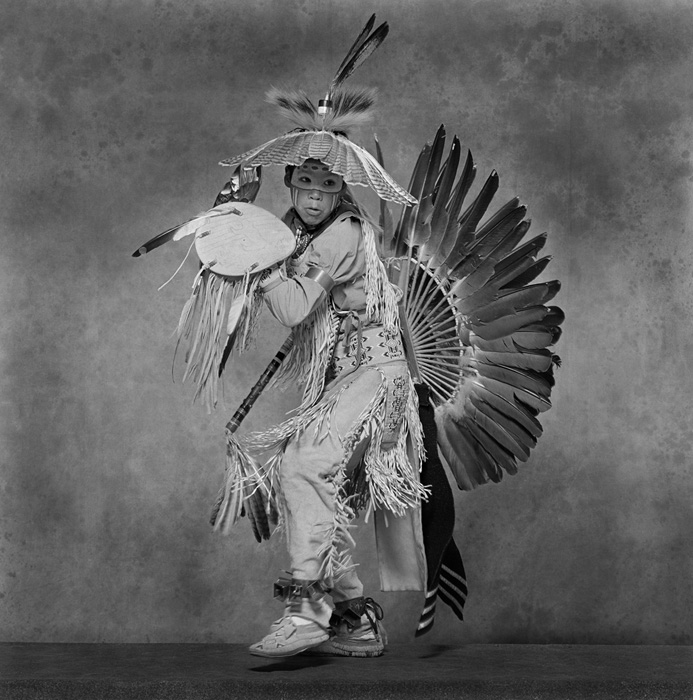
Artist's Statement: "Since I was a young boy I have been fascinated with photographs, especially historical photographs of First Nations people. I also wondered if my ancestors had photographed their world or was it just white men who made the images. I had many questions about what had taken place and with so few answers I set out to answer them myself. Along the way I met the popular American photographer Edward S. Curtis and his photographs of First Nations people and as my photographic practice matured, his work was always somewhere in the background. I was intrigued by the contrast between his view of First Nations people and the world I experienced as an urban-Iroquois, two very different yet related dancing grounds.
In 1995, award-winning Toronto photographer Myron Zabol began a five-year project to record, through the eyes of his camera, the lives and traditions of the Haudenosaunee, the Six Nations Iroquois, at the end of the twentieth century. This exhibition featured fifty black-and-white photographs that created a “portrait” of the complex values and beliefs of the Haudenosaunee people as expressed through their clothing and other means.
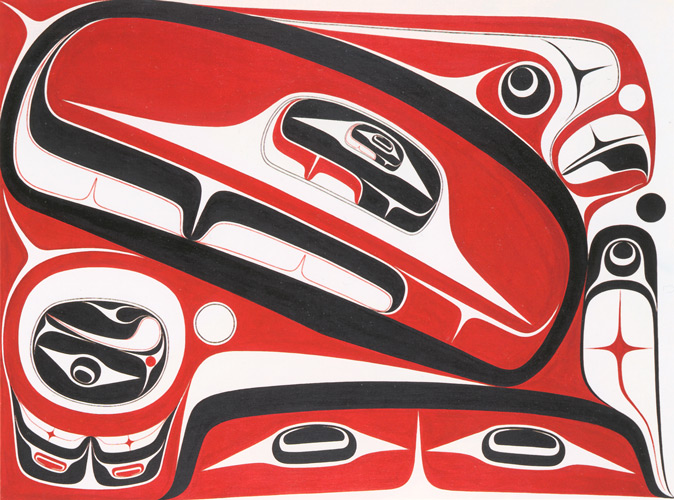
The exhibition presented thirty paintings and sculptures, including painted compositions on canvas, paper, deerskin drums, and cedar, as well as sculptures in both cedar and aluminum, by Haida artist guud san glans, Robert Davidson.
To many people, the Alaska Highway is simply a long line that connects two dots on a map. To others it is an essential transportation route, linking towns, cities and communities across northern Canada. To others, it is an engineering marvel − a symbol of a history of cooperation between two great nations. To the thousands of people that built it, however, the Alaska Highway was known simply as “The Road.”
The Festive North focused on celebration, showcasing images of traditional and contemporary Inuit games, drum dancing, throat singing, community gatherings and feasts, quite simply all things celebratory in Inuit Art. Traditionally, the great gatherings and celebrations centred on sharing and one of the most important things shared were the games. Games played an important role in the traditional semi-nomadic lifestyle; ensuring survival they helped to improve strength, dexterity, endurance and pain resistance.
During the 1950s, the term “contemporary Inuit sculpture” was used to distinguish new work from that produced during the Prehistoric and Contact eras. Today, however, the use of this term to cover a fifty-year period has made it something of a misnomer. This exhibition focused on sculpture created over the past decade and looks at what is really “contemporary” within Inuit sculpture.
This retrospective of Edwin Holgate’s work was the first since the artist’s death in 1977. The exhibition explored many aspects of this versatile artist’s production, including early works from his Montreal and Paris training, portraits of his Montreal circle of friends and family, paintings in oil and watercolour, his work as a war artist, and prints from his trip to the Skeena River region of British Columbia.
Norval Morrisseau, also called Copper Thunderbird, rose to fame in the 1960s when he developed the unique painting style known as the Woodland School. Today this art style is called Anishnaabe painting, a reference to the artist’s heritage, and the unique pictographic style influenced many other First Nations artists. This exhibition included rarely-seen or never before displayed pieces.
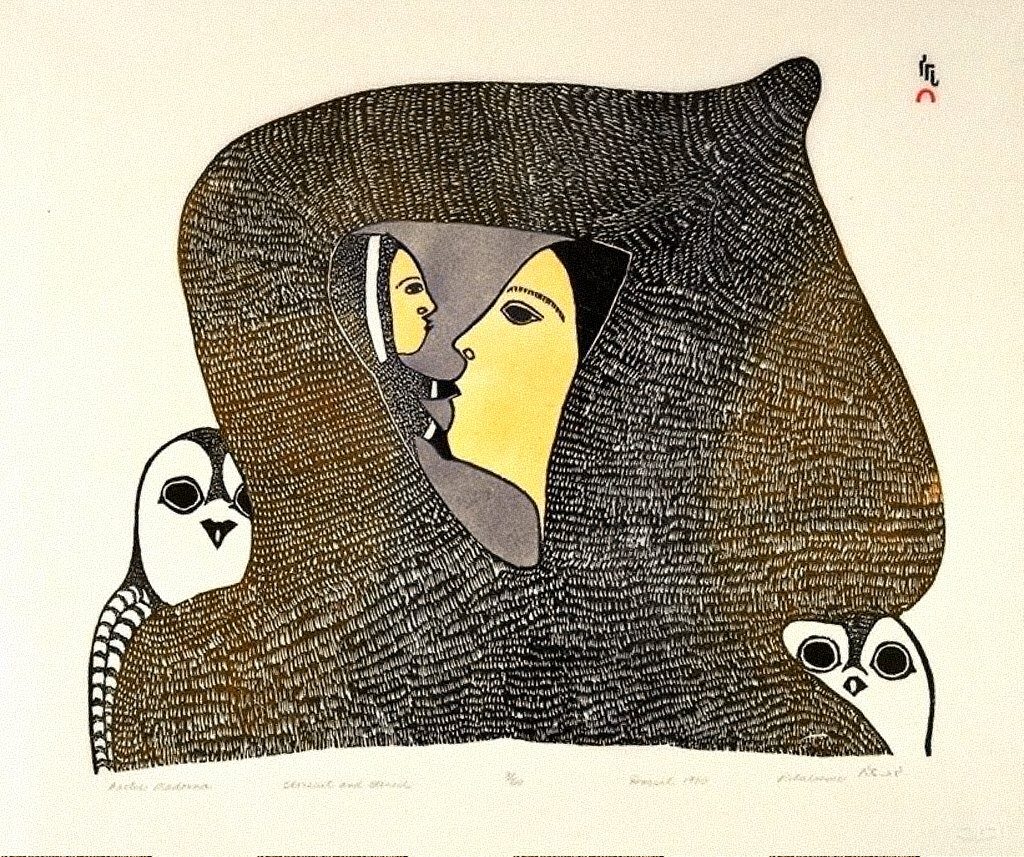
This exhibition showcased some of the best-known prints from Kinngait (Cape Dorset) with a focus on selected works by Kenojuak Ashevak, Pudlo Pudlat, Parr, Pitaloosie Saila, Pauta Saila, Kananginak Pootoogook, Sheojuk Etidlooie, Kingmeata Etidlooie, Pitseolak Ashoona, Lucy Qinnuayuak, Kiakshuk, Tudlik, and many other artists.