Bess Larkin Housser Harris
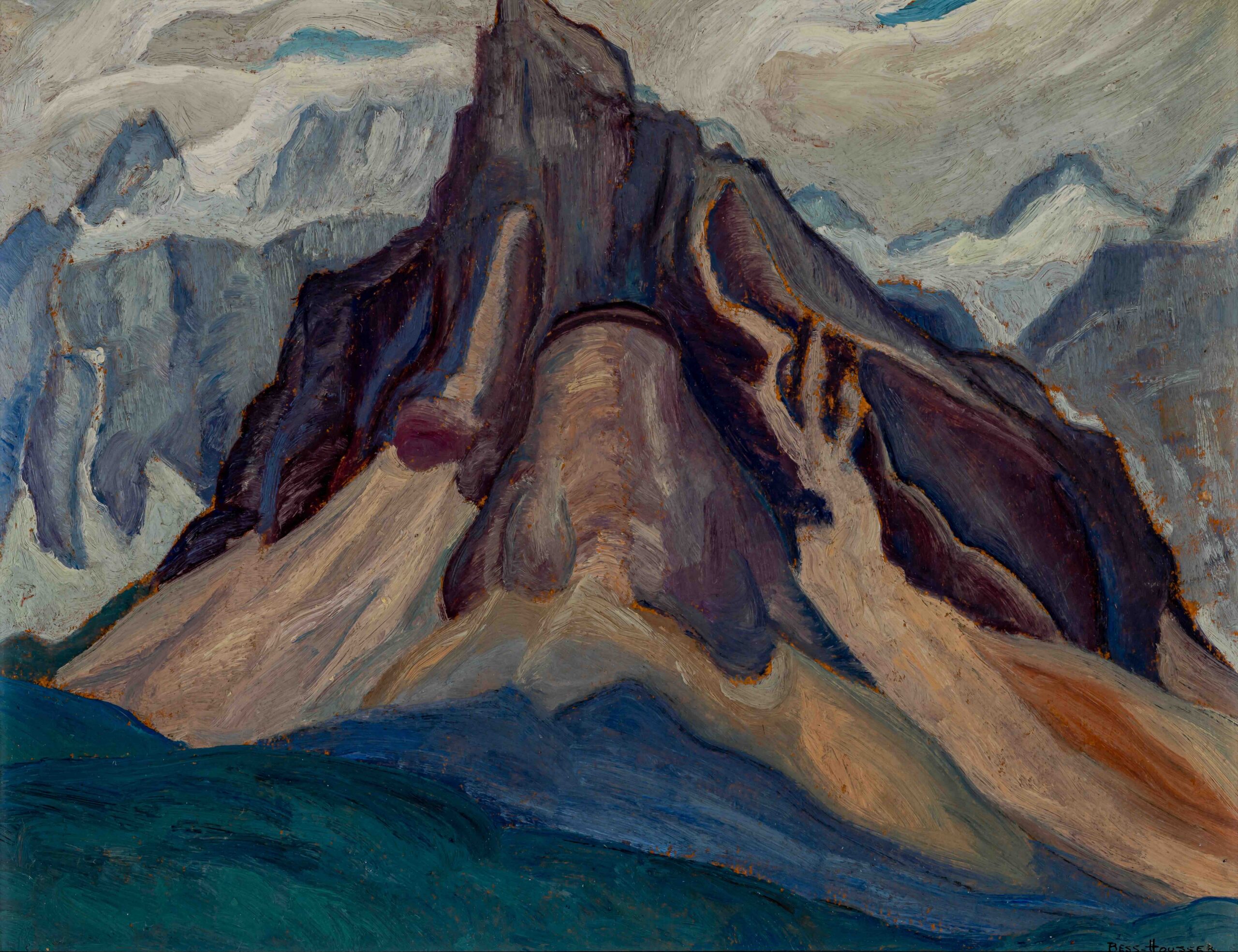
The paintings by Bess Harris record more than just the physical features of a place—they capture its spirit. Largely untrained, she was not restrained or impeded by the influence of a particular instructor or academic convention, allowing for her direct, intuitive response to the landscape. She was a spiritual person, and her brightly coloured, dynamically composed landscapes can best be described as sublime.
Born Bess Larkin in Brandon, Manitoba, in 1890, she attended boarding school at Havergal College in Toronto. In 1914, she married Fred Housser, an art critic and editorial writer for The Toronto Daily Star who was an early champion of the Group of Seven. Bess Housser soon became deeply embedded in the Canadian art community, despite not having attended art school. In addition to being an art collector, she was also a critic. Her column, “In the Realm of Art,” ran in Canadian Bookman from 1924 to 1926 and championed progressive artists and emerging modernist ideas.
In 1926, she began exhibiting art publicly as an invited contributor to Group of Seven shows. Her paintings were later shown with the Ontario Society of Artists, at the Canadian National Exhibition, with the Canadian Group of Painters, and internationally at the Corcoran Gallery of Art in Washington, DC. She excelled at painting the outdoors and travelled to the Rocky Mountains every year to paint the craggy snow-covered peaks.
Following her divorce from Fred Housser in the early 1930s, Bess married the artist Lawren Harris. Together they lived and painted in New Hampshire and New Mexico before settling in Vancouver. During these years, both artists turned increasingly toward abstraction, united by a belief “that there is a realm of spiritual realism that informs all great works of art,” and that such works can give life “a meaning that answers the higher aspirations of the soul.”1
In addition to her own artistic practice, Harris remained a dedicated advocate for her husband’s work. In the final year of her life, she collaborated with R.G.P. Colgrove to edit Lawren Harris, 1969, the first major monograph on his art. Although her legacy has often been overshadowed, Bess Harris’s contributions as both a writer and painter are significant. Her small but compelling body of work affirms her place as an artist of vision and independence deserving of recognition in her own right.
1. Lawren Harris, quoted in Bess Harris and R.G.P. Colgrave, eds., Lawren Harris (Toronto: Macmillan, 1969), 3.
Mountain Sketch
1928–29
In 1928, Bess Housser (later Harris) embarked on a sketching trip in Banff, Alberta, with the artists Isabel McLaughlin and Yvonne McKague (later Housser). Housser Harris painted this evocative sketch of the peak of Mount Babel seated a few yards away from McKague, who painted the same subject from a slightly different vantage point.
“I love the mountain country more than any country I have yet been in. They are utterly unlike what I expected to find,” Housser wrote to Doris Mills in 1928. She described the mountain country as creating “the friendliest mood of any land I know. I feel I could live in them and amongst them—alone and unlonely—I have never felt so free and so needless of fear with Nature.”
These sketching sojourns were important for artists, who found both camaraderie and inspiration working alongside their peers. Housser Harris eventually gave this sketch to McKague, who donated it to the McMichael in 1974.
Bess Larkin Housser Harris (1890–1969), Mountain Sketch, 1928–29, oil on wood panel, 27 x 34.6 cm, McMichael Canadian Art Collection, gift of Yvonne McKague Housser. Photo: Toni Hafkenscheid.

Above Moraine Lake
c. 1929
Housser Harris’s large-scale canvas is similar in subject and scale to the famed mountain paintings by Lawren Harris, the artist’s husband after 1934.
Like Harris’s work, Housser Harris’s painting expresses a deep and spiritual experience of the landscape of the Rocky Mountains, but where Harris’s canvases are geometric and cool, hers is sumptuous and fleshy.
Bess Larkin Housser Harris (1890–1969), Above Moraine Lake, c. 1929, oil on canvas, 111.8 x 139.1 cm, courtesy of Loch Gallery.

Lawren and Bess Harris at Parker Ridge, Jasper, Alberta, c. 1947. Photo attributed to Ira Dilworth. Courtesy of Stewart Sheppard.

Day’s End
c. 1928
In 1931, Housser Harris joined Yvonne McKague on another trip. This time the pair travelled with Isabel McLaughlin to Cobalt, Ontario—a mining boomtown that rose to prominence in the early twentieth century following the discovery of vast silver deposits.
This visit marked a high point in her exploration of atmosphere and mood in her work. During her time in Cobalt, she developed material for two of her most significant easel paintings: Old Mine Shaft, Cobalt, 1931, and Day’s End, c. 1932 (pictured left).
In Day’s End, Housser traces the diagonal sweep of one of the town’s winding hillside streets, capturing both an overcast sky and the fading light of dusk, a transitional moment in Cobalt’s daily rhythm.
Bess Larkin Housser Harris (1890–1969), Day’s End, c. 1928, oil on canvas, collection of Katia and John Bianchini. Photo: Craig Boyko.
related articles
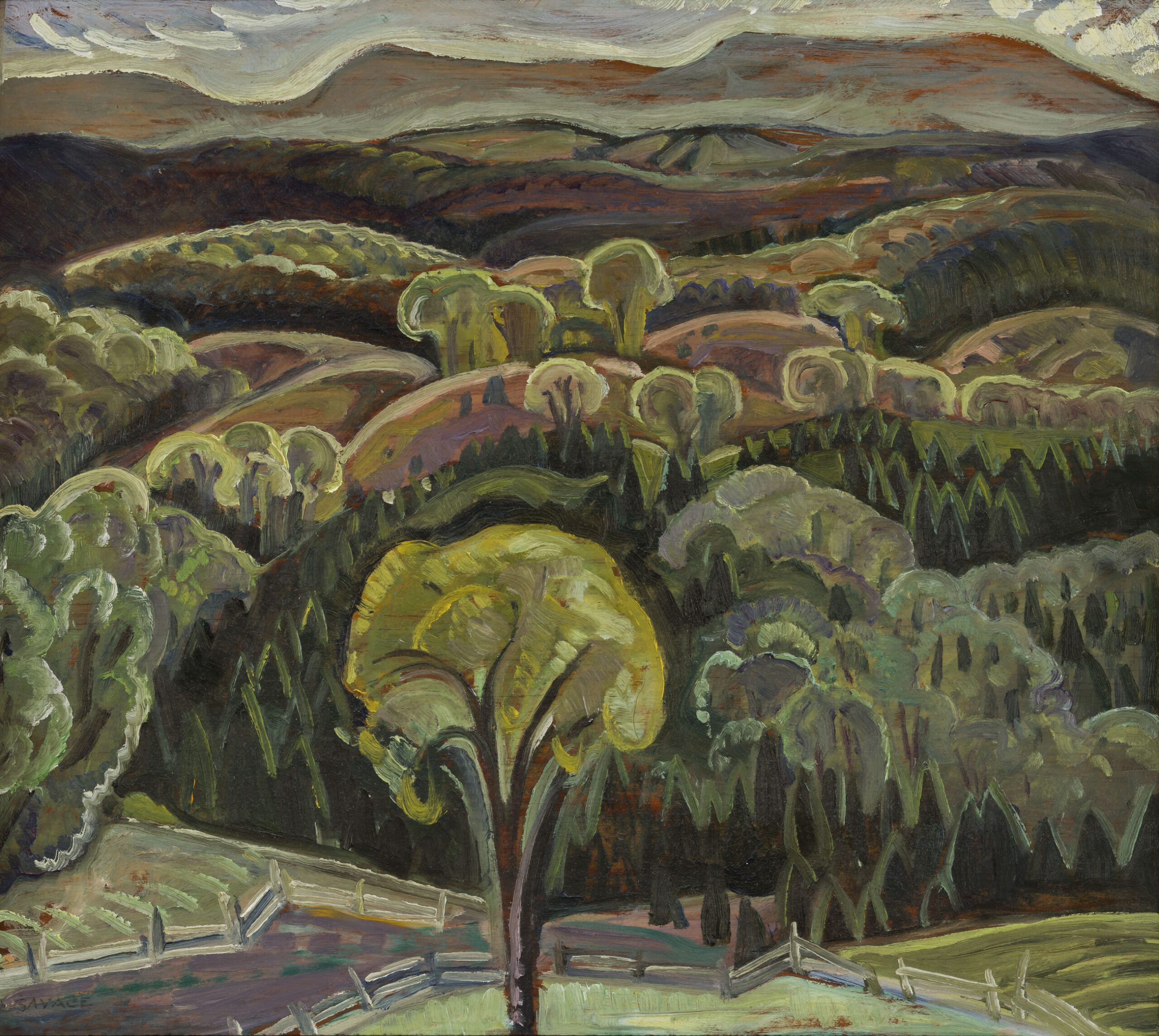
Artist Spotlight: Anne Savage
septembre 14, 2026Anne Savage painted landscapes full of rhythm, jewel-toned colour, and an intimate sense of place — from the hills of the Laurentians to the mountains of British Columbia — in whatever spare hours her teaching career allowed. Discover the life and practice of one of Canada’s most distinctive landscape painters in this artist spotlight by McMichael curator John Geoghegan.