Excerpt from
Margaux Williamson

Few artworks so fittingly reflect the premise of Fresh Air: New Acquisitions in Context, currently on view at the McMichael, than Margaux Williamson’s Meeting Place, 2021. Williamson’s canvas masterfully renders a familiar scene as beloved and yet still somehow uncanny, a dynamic that mirrors how the painting both recognizes and innovates on the nearby Ontario woodland scenes such as Tom Thomson’s Beech Grove, 1916, or Lawren Harris’s Wood Interior, Algoma, c. 1919. Williamson’s title refers to the porch in the foreground, a site for gathering, as well as to the five trees that stand in for the artist’s most cherished persons who were held in her recollections during the separation caused by the Covid-19 pandemic. Picking up on the themes of communion and collectivity, Williamson’s painting highlights the interconnectedness of nature and our roles in it as inhabitants and inheritors.
The exhibition catalogue Margaux Williamson was published on the occasion of her mid-career survey, Interiors, presented in 2021–22 at the McMichael. To highlight Meeting Place along with Williamson’s other significant contributions to contemporary art, we are including an excerpt from the catalogue by the guest curator, Jessica Bradley:
Williamson has said that painting can be a place to consider what is real and what has value. Such consideration leads her to make images unconstrained by the dictates of a preconceived composition and instead to build progressively with details that stay in the mind. In her studio, an unobtrusive garage behind her house on a downtown Toronto side street, Williamson yields to the slow process demanded by large oil paintings, constructing images that, like thoughts, unfold organically. The interiors that have become a dominant theme in her recent work are both literal spaces, somewhere comfortably familiar, and places of imaginative interiority where her inanimate subjects are brought under the spell of her anarchic treatment of space.
Williamson presents these banal realities as worthy of exploration and liberated from conventional hierarchies. An assortment of food and objects left overnight on the kitchen table, the light catching the rim of a glass, a box of discarded papers in the corner, or the glow of a laptop screen—all are given value and can seem to exist autonomously, their compelling presences honoured. The expanses of undifferentiated space she often leaves around them invite looking more closely. There is a frankness to her work that enlivens her canvases as fields of inquiry untethered from foreseeable resolution. Rather, a spaciousness in her images gives us licence to rove around details that become anchors in a field of possibilities.
An uncanny temporal element inhabits these spaces as objects are seen in fading light or emerging from darkness in dense strokes of paint that describe the intangibility of a moment. Williamson makes her paintings with a fluency that presents multiple and simultaneous relationships, as in collage. For her the brush stroke, the act of putting paint on canvas, anticipates both figuration and abstraction: the depiction of real objects situated in the fluid pictorial space and time unique to her work.

Margaux Williamson (b. 1976)
Meeting Place
2021
oil on canvas
157.5 x 228.9 cm
McMichael Canadian Art Collection
Gift of W. Bruce C. Bailey in honour of Katia and John Bianchini
2024.7
Photo: Craig Boyko

Tom Thomson (1877–1917)
Beech Grove
1916
oil on wood panel adhered to plywood
21.6 x 26.5 cm
McMichael Canadian Art Collection
Gift of the Founders, Robert and Signe McMichael
1966.16.71.

Williamson in her studio. Photo: Craig Boyko.

Fresh Air: New Acquisitions in Context
On view through July 26, 2026
Discover recent acquisitions presented in dynamic dialogue with long-held works from the collection.

related articles

“On Looking and Reading” from Early Days: Indigenous Art from the McMichael
novembre 10, 2025The Anishinaabe artist and scholar Bonnie Devine won the 2024 Galeries Ontario Galleries (GOG) Award for Curatorial Writing for her lead essay, “On Looking and Reading,” in our landmark publication Early Days: Indigenous Art at the McMichael.

Interview from Iris Häussler: Divided Heavens
novembre 10, 2025Toronto artist Iris Häussler is one of a number of Canadian artists who have made the Tom Thomson Shack on the McMichael property their temporary summer workspace, among them Robert Houle, Alexa Kumiko Hatanaka, Jen Aitken, and Zachari Logan. Häussler’s complex project incorporated her research on the death of migrating birds though collisions with glass—a phenomenon that kills more than twenty million migrating birds in Canada annually.

Interview from Stan Douglas: Tales of Empire
Décembre 27, 2025Read an excerpt from artist Stan Douglas’ conversation with McMichael Executive Director, Sarah Milroy.

Galeries Ontario / Ontario Galleries Award and Nominations
Décembre 23, 2025We’re delighted to share that the catalogue for our exhibition Worlds on Paper: Drawings from Kinngait won the Galeries Ontario / Ontario Galleries Award for Art Publication of the Year, 2025.

“Pegi Nicol MacLeod” from Uninvited: Canadian Women Artists in the Modern Moment
janvier 17, 2026In celebration of Pegi Nicol MacLeod’s birthday on January 17, we’d like to highlight an excerpt from Georgiana Uhlyarik’s essay on the beloved artist, featured in the McMichael’s Uninvited: Canadian Women Artists in the Modern Moment.

Excerpt from William Kurelek: Jewish Life in Canada
mars 4, 2026Read an excerpt from David S. Koffman’s essay, “Painting Jewish Life in Canada.”

Excerpt from Worlds on Paper: Drawings from Kinngait
mars 4, 2026Read an excerpt from Emily Laurent Henderson’s essay, “Dreaming Forward” from Worlds on Paper: Drawings from Kinngait.

Excerpt from People of the Watershed: Photographs by John Macfie
avril 1, 2026People of the Watershed brings John Macfie’s photographs of northern Indigenous communities into focus—discover how this intimate and far-reaching project captures lives, relationships, and a moment of profound change.

Excerpt from Uses of Enchantment
mai 7, 2026Marking the third anniversary of Uses of Enchantment: Art and Environmentalism, this article revisits Shary Boyle’s haunting explorations of apocalypse, fantasy, and environmental anxiety. Featuring an excerpt by writer Ruth Jones, it examines how Boyle’s imaginative works reflect contemporary fears surrounding climate change and ecological collapse.
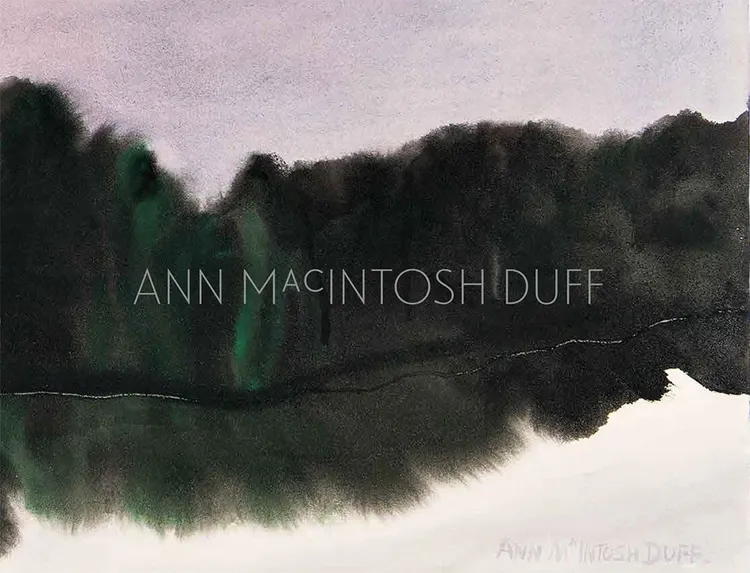
Excerpt from Ann MacIntosh Duff
septembre 14, 2026Ann MacIntosh Duff (1925–2022) spent decades returning to the same boathouse studio on Georgian Bay, finding endless new possibilities in familiar landscapes — and the McMichael is proud to have recently acquired two hundred works from her estate. Read an excerpt from award-winning filmmaker Jennifer Baichwal’s moving essay on her dear friend’s life and singular artistic vision.