Joseph Tisiga,
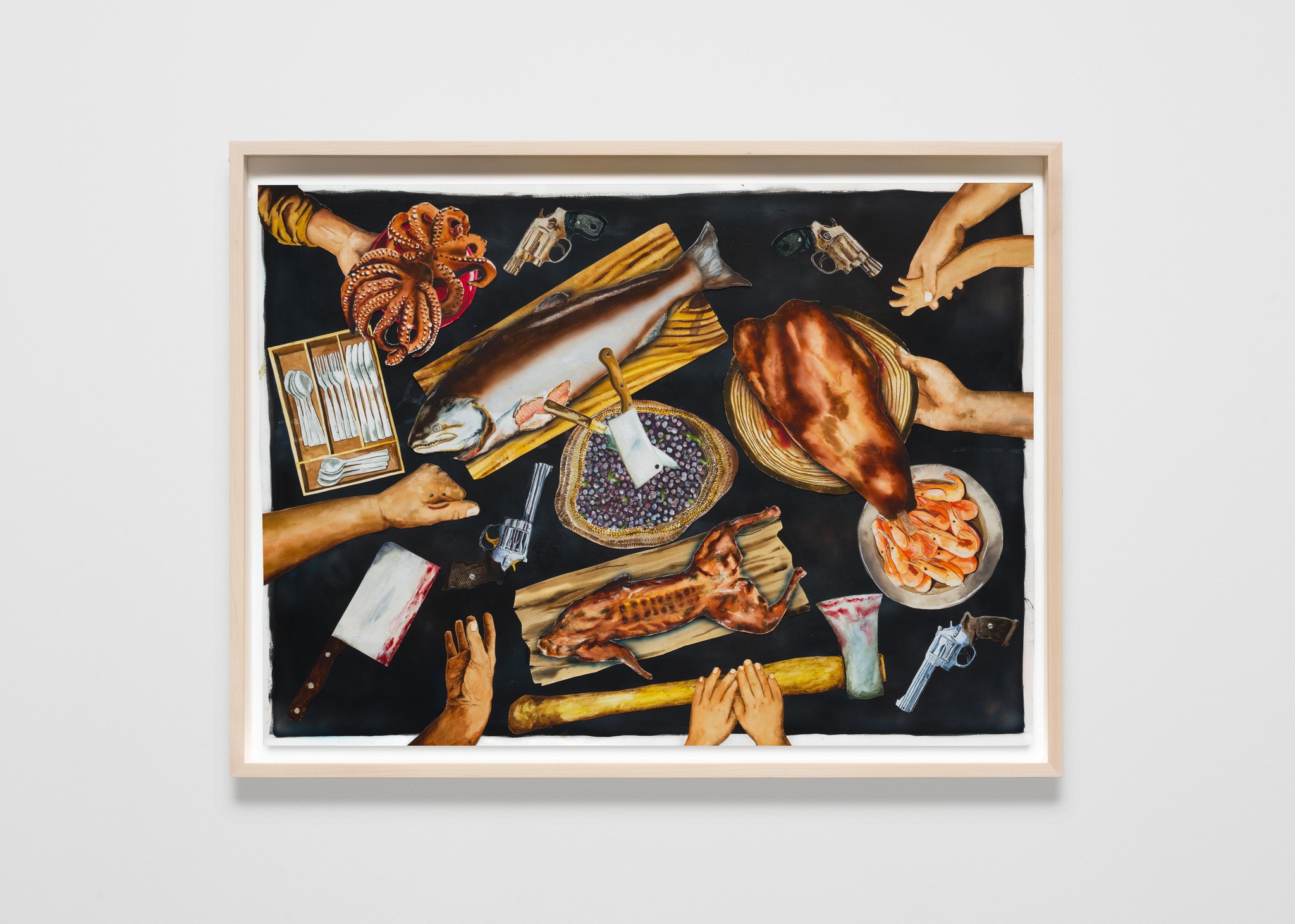
Theft of Scarcity, 2025
Joseph Tisiga is a multidisciplinary artist and member of the Kaska Dena Nation, whose traditional territories span what is now southeastern Yukon, northern British Columbia, and the southwestern Northwest Territories. Rooted in painting and drawing, his practice spans performance, photography, sculpture, and installation and explores identity, myth, memory, and the interplay of Indigenous and contemporary narratives.
The McMichael recently acquired Tisiga’s Theft of Scarcity, 2025, an artwork composed of collaged and painted elements affixed to the picture plane. Hands reach for a feast of traditional delicacies: rabbit, salmon, prawns, berries, Pacific octopus, and deer. Strewn about the table are kitchen utensils and knives, along with an axe and four handguns. The threat of scarcity has loomed over many Indigenous communities, the product of settler intervention, overharvesting of traditional foods, forced dispossession of lands, and the historical banning of feasts and potlatch traditions. The participants in Tisiga’s feast have armed themselves, ensuring that their bountiful meal will not be stolen or spoiled, a heartbreaking reminder that for Indigenous people, threats of violence are present even in moments of great joy.
Theft of Scarcity is displayed in an alcove space beside FISH, 2025–26, Sandra Brewster’s site-specific installation. Whereas Brewster’s fish reflect the adaptability, agency, and tenacity characteristic of diasporic experience, Tisiga renders a fresh catch as both sustenance and a means for bringing people together. What FISH and Theft of Scarcity allude to in common are the decisions that people must make to survive, both today and in centuries prior. While layering is also used to unique ends—gaps left in Brewster’s photo-based gel transfer evoke the elisions of memory, whereas Tisiga’s forms emerge from the picture plane to lend a lifelike immediacy to the scene—both artworks highlight that this struggle for a better life is a struggle often faced in community and in solidarity with others across the world.

Joseph Tisiga (b. 1984)
Theft of Scarcity
2025
watercolour on paper
101.6 x 139.7 cm
McMichael Canadian Art Collection
purchased with the generous support of the Dr. Michael Braudo Fund
2025.51
Photo: William Sabourin

View of the site-specific installation FISH, 2025–26, by Sandra Brewster at the McMichael Canadian Art Collection, 2025–26, acrylic, drawing, photo-based gel transfer on wall.

View of the site-specific installation FISH, 2025–26, by Sandra Brewster at the McMichael Canadian Art Collection, 2025–26, acrylic, drawing, photo-based gel transfer on wall.
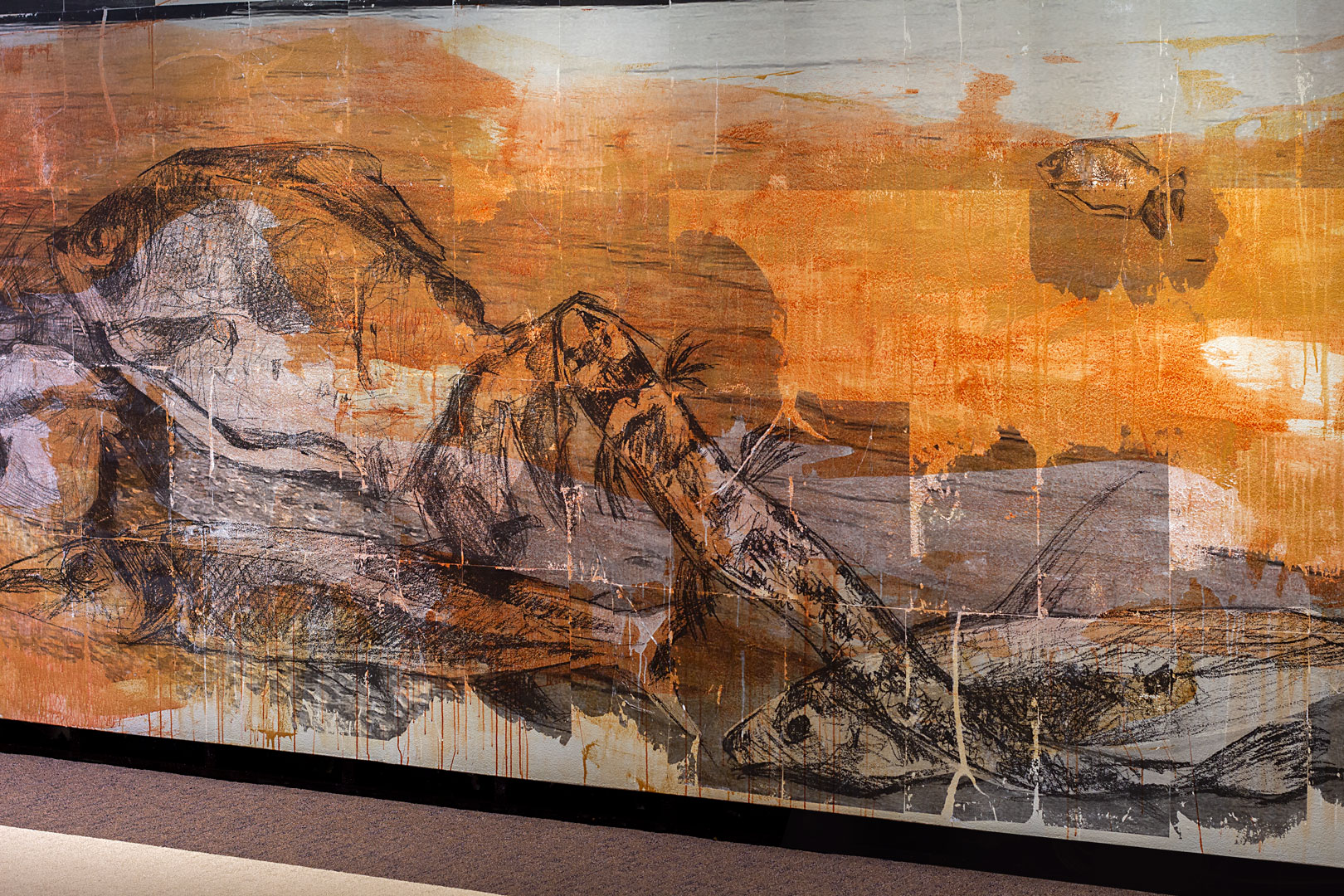
View of the site-specific installation FISH, 2025–26, by Sandra Brewster at the McMichael Canadian Art Collection, 2025–26, acrylic, drawing, photo-based gel transfer on wall.